

Introduction
The Emirati dialect is a linguistic mosaic, its vocabulary enriched by centuries of contact with other cultures through trade, migration, and empire. It is not a closed system but a dynamic and adaptive language that has absorbed and integrated words from various tongues. The most significant influences come from Persian (Farsi), English, and Swahili, each representing a different chapter in the region’s history as a global crossroads. These loanwords are not foreign impositions but have been seamlessly woven into the fabric of daily speech, telling a story of maritime trade, colonial encounters, and cultural exchange.
The Persian Imprint: Ancient Neighbors and Shared Seas
Given the UAE’s proximity to Iran and a long history of maritime trade and migration across the Gulf, the Persian influence is deep and enduring. Many of the borrowed words relate to architecture, domestic life, and seafaring, reflecting the areas of closest contact.
- Architecture & Home: Dallah (coffee pot), menjel (winnowing basket for dates), bargeel (wind tower).
- Food: sambosa (a fried pastry), jisht (a type of dried yogurt).
- Nautical Terms: dhow (the traditional sailing vessel), bandar (port).
- Other Common Words: bara (outside), doch (way/manner).
These words are so fully integrated that most Emirati speakers use them without a conscious awareness of their Persian origins; they are simply considered part of their own language.
The Swahili Connection: The Legacy of East African Trade
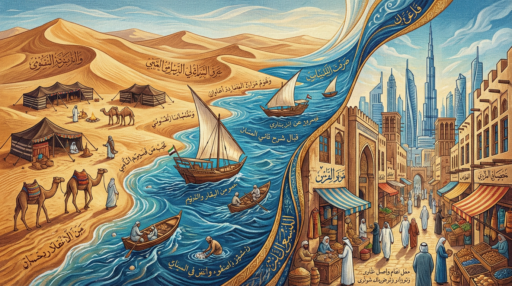
The monsoon winds not only carried dhows to India but also down the coast of East Africa. For centuries, there was a vibrant trade and cultural exchange between the Arabian Gulf and the Swahili Coast (modern-day Tanzania, Kenya, and beyond). This led to a smaller but distinct layer of Swahili loanwords in the Emirati dialect, primarily related to household items and food.
- Household: sufra (the cloth spread on the floor for meals), kasha (a wardrobe or cupboard).
- Food: mchuzi (curry), a testament to the culinary exchange that also passed through the Indian subcontinent.
The presence of these words is a linguistic footprint of the UAE’s historical role in the wider Indian Ocean world, a network that long predates the modern global economy.
The English Ascendancy: The Language of Modernity and Globalization
The most recent and rapidly growing influence on the Emirati dialect is English. This began during the British protectorate era (the Trucial States) but has accelerated dramatically with the UAE’s rise as a global business and tourism hub in the late 20th and 21st centuries. English loanwords are overwhelmingly related to technology, modern commerce, and education.
- Technology: “computer,” “mobile,” “internet,” “software.”
- Education & Work: “university,” “project,” “manager,” “meeting.”
- Daily Life: “shopping,” “jacket,” “t-shirt,” “party.”
This borrowing is often pragmatic, filling lexical gaps for new concepts. A common phenomenon is code-switching, where Emiratis fluidly mix English and Arabic words within a single sentence, a natural adaptation to a bilingual environment.
Integration and “Emiratization” of Loanwords
When foreign words are adopted, they are often adapted to fit the phonological and grammatical rules of Arabic. They are given Arabic plurals (e.g., “computerat”) and conjugated according to Arabic patterns. This process of naturalization demonstrates the dialect’s robustness and its ability to absorb external influences while maintaining its fundamental structure. The words are not merely borrowed; they are remade and owned, becoming authentic components of the Emirati linguistic identity.
Conclusion: A Living Record of Cross-Cultural Dialogue
The layered vocabulary of the Emirati dialect is a living record of the nation’s open and interconnected history. It proves that cultural purity is a myth and that the strongest languages are often those that are most open to the world. The Persian, Swahili, and English words are not stains on the language but threads in its rich tapestry. They tell a story of merchants and sailors, of ancient neighbors and modern partners, reminding us that the UAE has always been a place where cultures meet, trade, and leave their mark, not just on the landscape, but on the very words its people speak.